


 Home
Home
National Policy Development On Digital Economy
1. DIGITAL ECONOMY IN MALAYSIA
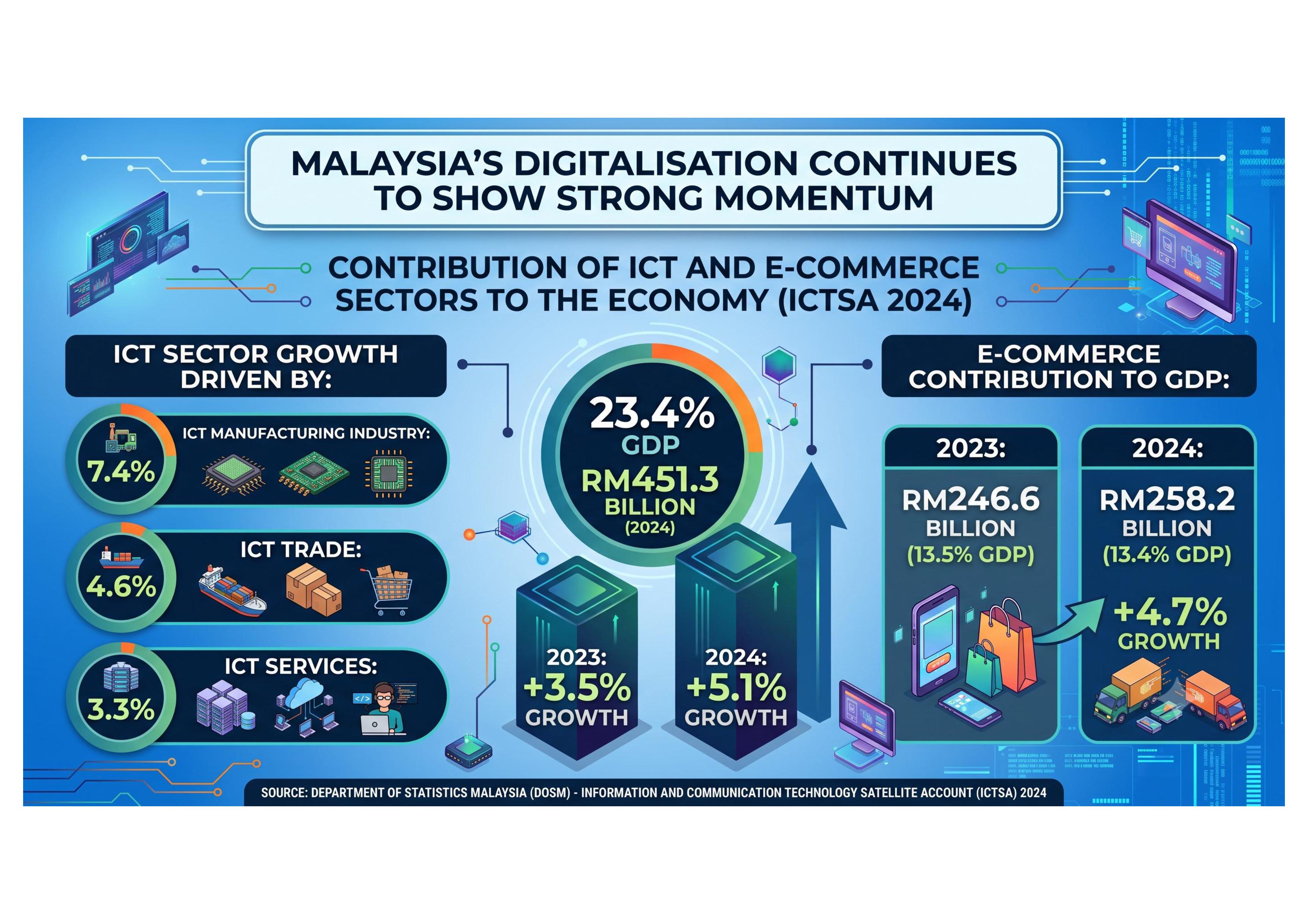
- Current digitalisation developments have shown much promise for our future. According to the latest available Report of Information and Communication Technology Satellite Account (ICTSA) 2024 published by the Department of Statistics Malaysia (DOSM) on 15 October 2025, ICT and e-commerce contributed 23.4 per cent to Malaysia's economy, valued at RM451.3 billion in 2024. Hence, the performance of ICT and e-commerce registered a further growth of 5.1 per cent as against 3.5 per cent recorded in 2023.
- The ICT performance was driven by the ICT manufacturing industry, which accelerated to 7.4 per cent from 2.4 per cent in the preceding year. This was followed by the ICT services industry and ICT trade industry with a growth of 3.3 per cent and 4.6 per cent respectively.
- In 2024, the e-commerce contribution to GDP was at RM258.2 billion (13.4 per cent), compared to RM246.6 billion (13.5 per cent) in 2023, posted a growth of 4.7 per cent in 2024 compared to 3.0 per cent in the preceding year.
2. NATIONAL POLICY ON DIGITAL ECONOMY DEVELOPMENT
- The Policy - MyDIGITAL
- The MyDIGITAL Agenda was launched on 19 February 2021, to represent the Government aspiration in continuously transforming Malaysia into a digitally-driven and a high-income nation by 2030.
- The Governance - Council of Digital Economy and the Fourth Industrial Revolution (MED4IRN)
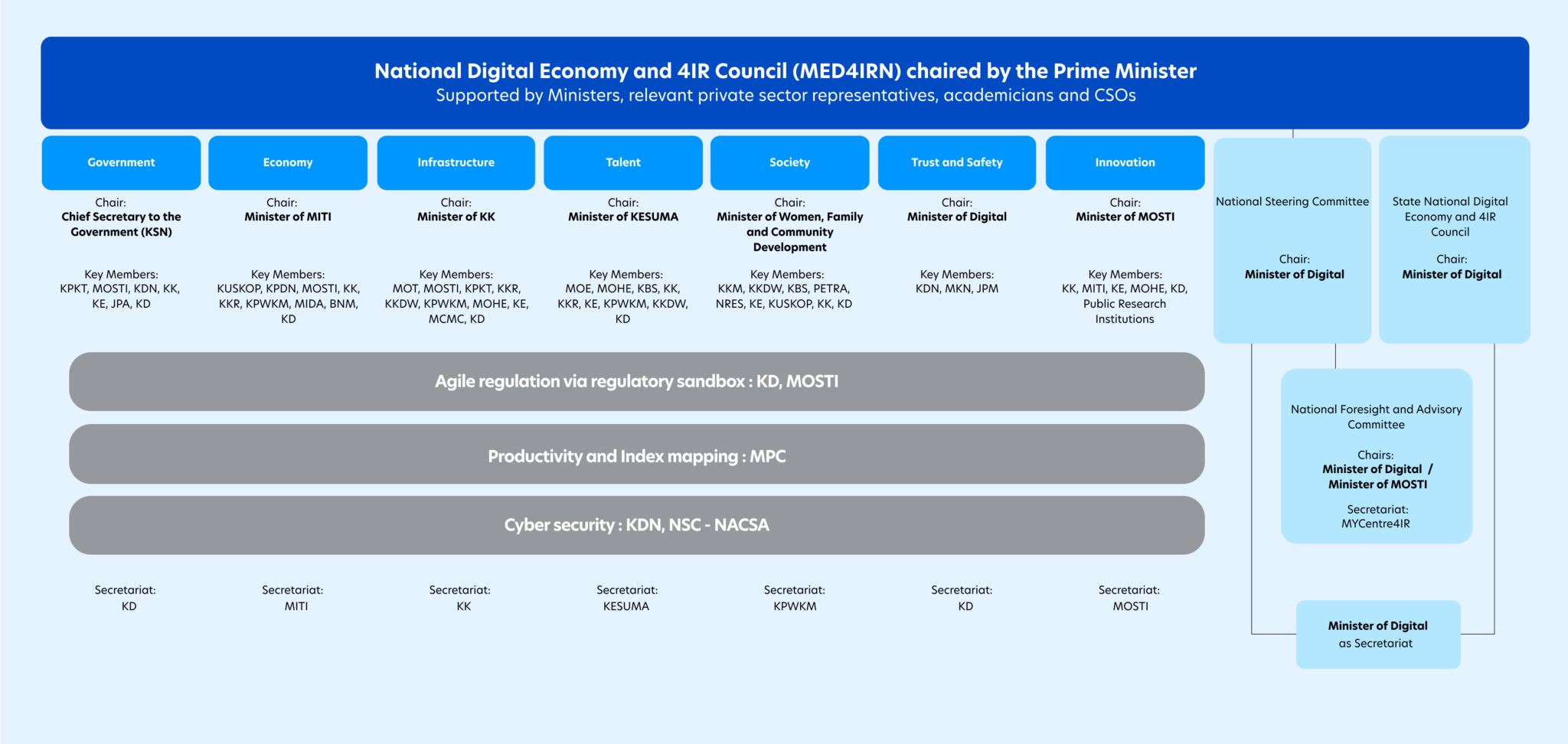
- The Council of Digital Economy and the Fourth Industrial Revolution (MED4IRN), under the stewardship of YAB Prime Minister of Malaysia, oversees the MyDIGITAL Agenda.
- The Council is supported by seven (7) clusters to focus on key development in the areas of:
- The Government Cluster - lead by Chief Secretary of the Government (KSN)
- The Economy Cluster - lead by Minister of Investment, Trade and Industry (MITI)
- The Infrastructure Cluster - lead by Minister of Communications (KK)
- The Talent Cluster - lead by Minister of Human Resources (MOHR)
- The Society Cluster - lead by Minister of Women, Family and Community Development (KPWKM)
- The Trust and Safety Cluster - lead by Minister of Digital (KD)
- The Innovation Cluster - lead by Minister of Science, Technology and Innovation (MOSTI)
- Apart from Cabinet Ministers, the Council also comprises representatives from the private sector, industries, academia and think tank luminaries, who will spearhead efforts to continue the nation's development, focusing on intensive digitalisation cutting across all aspects of economy and life.
- Malaysia Digital Economy Blueprint (MDEB) Phase 2, 2021-2025
- The Malaysia Digital Economy Blueprint (MDEB) Phase 2, 2021–2025 is a national strategic framework aimed at accelerating Malaysia’s transition into a high-income, digitally driven economy. Aligned with the 12th Malaysia Plan, the blueprint focuses on strengthening digital infrastructure, enhancing digital skills, and promoting digital adoption across government, businesses, and society.
- It targets increasing the digital economy’s contribution to GDP, expanding e-commerce activities, and creating digital job opportunities while ensuring inclusive participation, particularly among MSMEs. Overall, it serves as the foundation for Malaysia’s long-term digital transformation towards a fully digital and innovation-led economy.
- Malaysia Digital 2030 (MD2030) Action Plan Phase 3, 2026 - 2030
- The Prime Minister launched the Malaysia Digital 2030 (MD2030) Action Plan as a continuation of the Malaysia Digital Economy Blueprint (MDEB) for the 2021–2025 period on 29 June 2026.
- MITI as the Chair and Secretariat for the Economic Cluster, responsible for monitoring and coordinating 5 strategies, 10 initiatives and 29 programmes implemented by various ministries and agencies.
3. BDE FUNCTIONS
- Coordinating the implementation of digitalisation policies and digital trade ecosystem development initiatives in international trade and investment.
- Formulating and coordinating policies and initiatives to promote digital investment growth (e.g., Digital Investment Office).
- Coordinating Malaysia's position in negotiations regarding the trade digitalisation agenda under Free Trade Agreements (FTAs) as well as bilateral, regional, and international forums.
- Coordinating MITI's role as the lead for the Economy Cluster under the National Digital Economy and 4IR Council (MED4IRN), and managing inter-ministry and agency initiatives under the Malaysia Digital Economy Blueprint (Malaysia Digital 2030 (MD2030)), 2021–2030.
4. ASEAN DIGITAL ECONOMY FRAMEWORK AGREEMENT (DEFA)
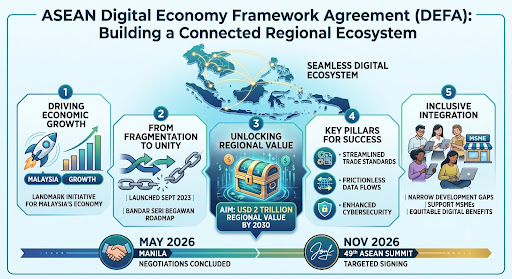
- The ASEAN Digital Economy Framework Agreement (DEFA) is a landmark initiative designed to build a seamless, secure, and inclusive regional digital ecosystem, serving as a driver for Malaysia’s economic growth.
- Launched in September 2023 under the Bandar Seri Begawan Roadmap, DEFA transitions ASEAN from fragmented bilateral deals into a unified legal framework for the world's fastest-growing internet economy.
- By streamlining digital trade standards, enabling frictionless cross-border data flows, and enhancing cybersecurity, DEFA aims to unlock USD 2 trillion in regional value by 2030.
- Beyond trade, DEFA serves as an integration tool to narrow development gaps, support MSMEs, and ensure equitable digital benefits across all member states.
- Negotiations concluded in May 2026 in Manila, with official signing targeted for the 49th ASEAN Summit in November 2026.
Other Link
- Malaysia Digital 2030 (MD2030): https://www.mydigital.gov.my
- Malaysia, Heart of Digital ASEAN: Digital Investment Office: https://www.heartofdigitalasean.my
- National e-Commerce Strategic Roadmap: https://mdec.my/nesr
- SME Digital Accelerator: https://mdec.my/digital-economy-initiatives/
- Soft Financing Scheme for Digital and Technology: http://www.midf.com.my/index.php/en/what-we-do-en/sme-financing
- eUsahawan Portal: https://mdec.my/eusahawan